Uganda Safari Cost
What a Uganda safari actually costs: budget/mid/luxury per-day bands, gorilla and chimp permits, park fees, vehicle hire, fuel, and US-dollar cash rules.
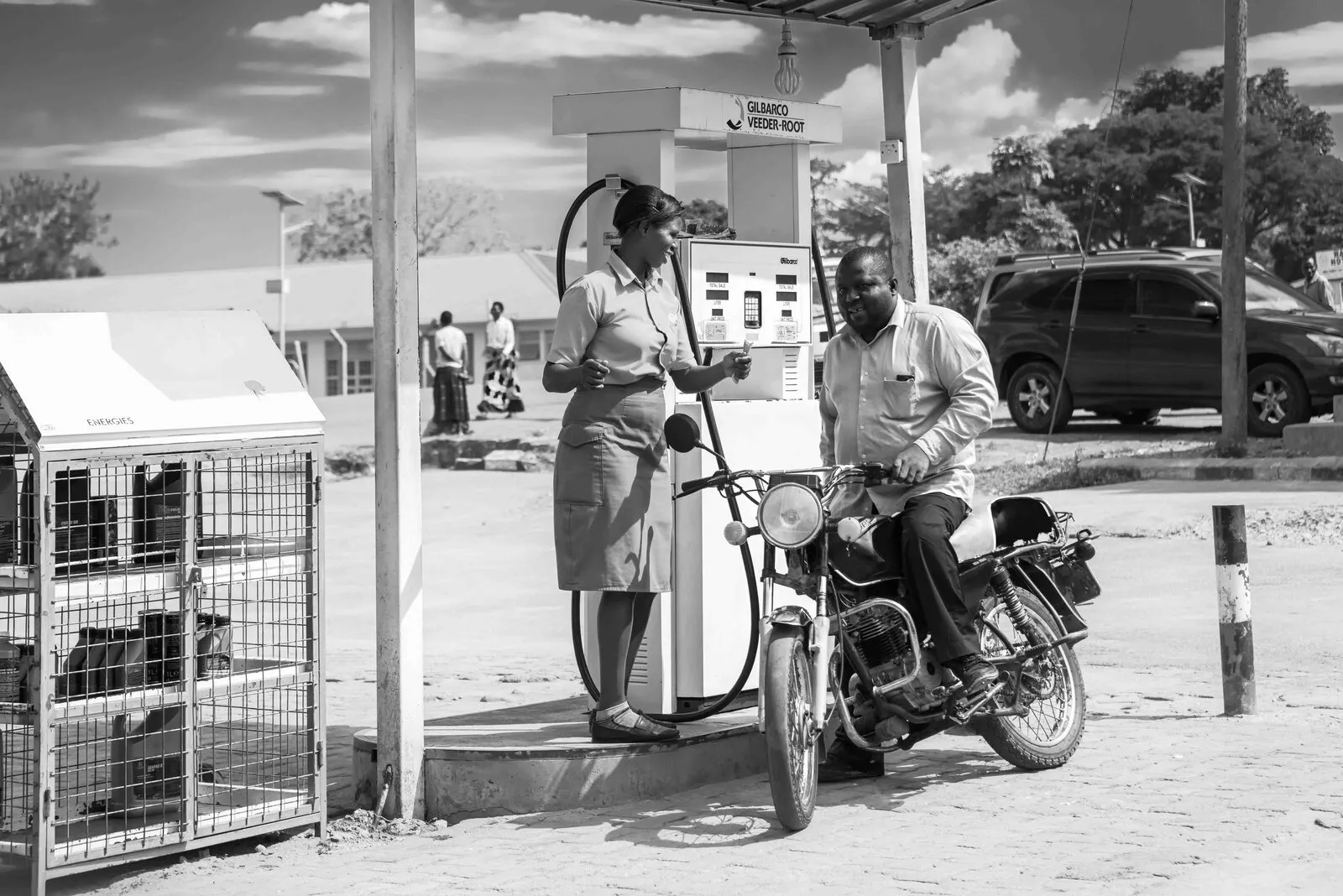
Photo: Rod Waddington, CC BY-SA 2.0, Wikimedia Commons
Why go
Ask five different sources what a Uganda safari costs and you’ll get five different numbers, and the honest reason is that they’re rarely measuring the same thing. SafariBookings, an aggregator that tracks pricing across dozens of vetted Uganda operators, publishes daily per-person averages — $300 budget, $425 mid-range, $700 luxury, for a shared group trip — built from accommodation comfort tiers: camping, standard lodges, or premium properties. Gorilla Pathfinders, a Uganda-based operator, posts a wider $200–$1,200+ daily range on Instagram, sliced into similar budget/mid/luxury bands but pricing a fully inclusive package — transport, guide, meals, and park fees bundled together — rather than accommodation alone. Neither number is wrong. They’re answering slightly different questions, and a page that only quotes one of them without saying which question it’s answering isn’t actually helping you budget.
What almost every source agrees on, and what most daily-rate headlines leave out, is that gorilla and chimpanzee permits sit entirely outside those per-day figures. A standard Bwindi gorilla permit is $800 for foreign non-residents; a standard Kibale chimp permit is $250. Book both, which most first-time Uganda itineraries do, and that’s $1,050 per person before a single night’s accommodation is paid for — genuinely a fifth or more of a mid-range trip’s total cost, and the single biggest line item most travelers underestimate going in. This page exists to put the pieces back together: the daily rate, the permits, the park fees, the vehicle, the fuel, and the cash logistics that actually determine what a Uganda trip costs once you add it all up.
There’s a second reason this matters beyond just budgeting accurately: several of these costs move on a real, documented schedule, not a vague “prices may vary” disclaimer. UWA’s own 26 February 2026 memo cut gorilla and chimp permit prices for three specific months — April, May, November — while leaving every other month’s rate untouched, and separately announced a further increase to the Gorilla Habituation Experience taking effect 1 January 2027. Fuel prices move week to week with global markets. Even the guidance on which US dollar bills Uganda’s forex bureaus will accept has genuinely tightened over the past several years rather than staying fixed. A cost page that doesn’t track its own currency is worse than useless — it’s actively misleading — which is why every figure below is dated to when it was actually checked.
Getting there
Start with the two costs that are fixed by government tariff and don’t vary by operator, lodge, or negotiating skill: permits and park entrance fees. Gorilla tracking is $800 for foreign non-residents (also $700 foreign resident, $500 Rest-of-Africa, UGX 300,000 East African Community), dropping to $600/$500 in April, May, and November only, non-reschedulable once booked. Chimpanzee tracking at Kibale is $250 FNR / $200 FR / UGX 180,000 EAC, with its own low-season cut to $200/$150 in the same three months — a discount that applies specifically to Kibale’s headline chimp permit, not to Queen Elizabeth’s cheaper Kyambura Gorge alternative at $100 FNR, which stays flat year-round. Park entrance fees layer on top of activity permits on days without a tracking permit attached, and they’re genuinely tiered: Murchison Falls sits in its own higher Category A+ bracket at $45 FNR, while Bwindi, Queen Elizabeth, and Kibale share a $40 Category A rate, and Rwenzori and Mount Elgon sit lower still at $35 Category B. Whether a given day’s entrance fee is separate or already bundled depends on the specific activity — UWA’s own tariff document states gorilla permits include that day’s park entrance, and chimp tracking rates “exclude entrance fees except for Kibale,” meaning Kibale’s chimp permit bundles entrance while Kyambura Gorge’s doesn’t.
Getting between parks is where the real cost variability shows up, because it’s the one major budget line that isn’t set by a government tariff. A self-drive 4x4 runs $55–$200 a day depending on vehicle size, per Self Drive Uganda’s own published fleet rates; add a driver-guide and that climbs to roughly $150–$250 a day all-in, or $30–$60 a day on top of a self-drive base if you’re adding one separately, plus modest driver accommodation and meal costs at your lodge each night. Fuel is its own real expense on top of the vehicle rate, not a rounding error: petrol and diesel both currently run around $1.60–$1.66 a litre, and a safari-spec Land Cruiser burns noticeably more crossing rough park tracks than it does on tarmac highway between towns. Whether self-drive or driver-guide makes more sense genuinely depends on your comfort with Uganda’s road conditions and your budget ceiling — self-drive is real money saved for confident, experienced travelers, while a driver-guide buys local knowledge, better wildlife spotting, and a real safety margin on rougher stretches, which matters more on a first Uganda trip than the daily rate difference might suggest.
Cash logistics are the last piece, and the one most likely to catch a first-time visitor off guard. Uganda’s forex bureaus, hotels, and safari operators generally deal in US dollars for large payments, but the standard for which bills they’ll actually accept keeps tightening: current sources range from rejecting anything printed before 2009 or 2010 up to a November 2024 tour-operator source recommending 2017-series notes or newer, with older or worn bills either refused outright or exchanged at a visibly worse rate. There’s no single official government cutoff published anywhere we could find — this is real-world, operator-reported practice, not law — which is exactly why the safe move is asking your bank for the newest, cleanest bills available before you fly, rather than assuming a rule you read a few years ago still holds.
When to go
Most of what’s on this page doesn’t move with the season — a Category A park entrance fee costs the same in April as it does in August, and SafariBookings’ daily rate bands aren’t published as seasonal figures. The exception that actually matters is the one this page keeps circling back to: UWA’s 2026 low-season gorilla and chimp permit discounts, live specifically in April, May, and November, and nowhere else on the calendar. That’s real money — $200 off a gorilla permit, $50 off a chimp permit, per person — for accepting muddier trails and a smaller crowd, and it’s the single biggest seasonal lever available on a Uganda safari budget. The tradeoff worth knowing before you build a trip around it: those discounted permits are explicitly non-reschedulable, so build genuine confidence in your travel dates before locking one in, not just a hope that the weather cooperates.
Fuel and vehicle-hire rates aren’t tied to Uganda’s tourist seasons in any documented way, but they do move with global fuel markets and general demand for rental fleets during peak travel windows, so a quote gathered in low season isn’t guaranteed to hold if you rebook closer to June–August or December–February, Uganda’s two dry, high-demand windows. The practical habit worth building either way: get vehicle and driver-guide quotes close to your actual travel dates rather than months in advance, since — unlike the government-set permit and park-fee tariffs — these are market rates that genuinely shift.
The numbers
| What you pay | Cost |
|---|---|
| Budget safari, per person per day (group rate, camping-based) SafariBookings' own published Uganda average, checked directly today. Their full breakdown shows $350 for the same tier priced privately rather than in a group — the $300 figure specifically assumes joining a shared group departure | $300 |
| Mid-range safari, per person per day (group rate, lodge accommodation) SafariBookings — $475 for the private-trip equivalent. Mid-range typically means en-suite lodge or tented camp rooms rather than shared camping | $425 |
| Luxury safari, per person per day (group rate, premium lodges) SafariBookings — $750 private, and their table lists a further "Luxury Plus" private tier starting at $1,050+ for the highest-end properties. Rates exclude international flights, tips, and personal spending | $700 |
| Gorilla Tracking permit, Bwindi — standard/high season (FNR / FR / ROA / EAC) UWA Conservation Tariff, July 2024–June 2026 cycle. Drops to $600/$500 (FNR/FR) in April, May and November only, non-reschedulable — see the Gorilla Permits guide for the full breakdown | $800 / $700 / $500 / UGX 300,000 |
| Chimpanzee Tracking permit, Kibale — standard/high season (FNR / FR / EAC) UWA Conservation Tariff. Drops to $200/$150 (FNR/FR) in the same three low-season months as the gorilla discount, per UWA's 26 Feb 2026 memo. Queen Elizabeth's Kyambura Gorge sells a cheaper chimp permit, $100 FNR, though sightings there are less reliable than Kibale's larger habituated groups | $250 / $200 / UGX 180,000 |
| Park entrance fees, per day, by UWA category (FNR / FR / ROA / EAC) UWA Conservation Tariff. Murchison sits in its own, higher A+ tier — a common misconception is that it's priced the same as Bwindi or Queen Elizabeth, but it isn't. Usually bundled into guided park activities rather than paid as a separate line yourself | A+ (Murchison) $45/$35/$30/25,000 · A (Bwindi, QENP, Kibale) $40/$30/$25/20,000 · B (Rwenzori, Elgon) $35/$25/$20/15,000 |
| 4x4 vehicle hire, self-drive vs. with a driver-guide, per day Self Drive Uganda's own published fleet runs $55 (Rav4) to $130 (Land Cruiser LX 78-series) self-drive; Mumwe Safaris quotes a broader $100–$200 self-drive band for a full-size Land Cruiser and $150–$250 with a driver included. Adding a driver to a self-drive rental separately typically runs $30–$60/day on top, plus roughly $10–$20/night driver accommodation and $10–$15/day driver meals at your lodge | $55–$200 self-drive · $150–$250 with driver |
| Fuel, petrol and diesel, per litre GlobalPetrolPrices, 27 Jul 2026: UGX 6,250/litre petrol, UGX 6,105/litre diesel. Mumwe Safaris independently quotes a very similar $1.40–$1.60/litre range for trip-planning purposes. A safari-spec Land Cruiser burns noticeably more on rough park tracks than on tarmac — budget fuel as a real trip-length cost, not an afterthought | ≈$1.62–$1.66 (petrol) / ≈$1.62 (diesel) |
| Tipping, driver-guide (per day) and gorilla-trek porter (per trek) Driver-guide range per White Plains Safaris' published guidance, described as "a fair benchmark" to confirm with your operator. Porter figures reused from the Gorilla Permits guide — porters are hired locally, not through UWA, and the tip goes directly to them | $10–$20/day driver-guide · $15–$20 porter hire + $5–$15 tip |
Common questions
What's a realistic per-day safari budget in Uganda?
SafariBookings, an aggregator that tracks pricing across vetted Uganda operators, publishes $300 a day for a budget group trip, $425 for mid-range, and $700 for luxury — all per person, and all assuming a shared group departure rather than a private vehicle (their private-trip figures run $350/$475/$750, with a further "Luxury Plus" tier above $1,050). Two Instagram posts from Gorilla Pathfinders, a Uganda-based tour operator, independently describe a wider $200–$1,200+ per person daily range broken into budget ($200–$350), mid-range ($350–$600), and luxury ($600+) bands — a real but different way of slicing the same market, since it's quoting inclusive package pricing (transport, guide, meals, park fees bundled) rather than SafariBookings' accommodation-tier averages. Neither figure includes gorilla or chimp permits, which are large, separate costs layered on top — see the next answer.
How much do gorilla and chimp permits actually add to the trip?
A lot, and it's worth budgeting for explicitly rather than folding into a daily rate. A standard Bwindi gorilla permit is $800 for foreign non-residents; a standard Kibale chimp permit is $250. Together that's $1,050 per person before a single night of accommodation or a litre of fuel is paid for. Both permits do get cheaper in April, May, and November specifically — $600 gorilla, $200 chimp — under UWA's 2026 low-season pricing, a genuine ~25% and ~20% discount respectively, though both discounted permits are non-reschedulable once booked. A 10-day trip covering both activities, at SafariBookings' mid-range daily rate, works out to roughly $425 × 10 + $1,050 = $5,300 per person — permits are easily a fifth of a mid-range trip's total cost.
Should I rent a self-drive 4x4, or hire one with a driver-guide?
Self-drive is meaningfully cheaper on paper — Self Drive Uganda's own published rates start at $55/day for a compact SUV and top out around $130/day for their largest Land Cruiser, versus $150–$250/day once a driver-guide is included. But the driver isn't just a convenience: Uganda's park roads are genuinely rough in places, a driver-guide who knows the terrain and the wildlife-spotting patterns adds real value on a game drive, and self-drive rental math still needs to add fuel, which runs noticeably higher off tarmac. If it's your first Uganda trip or you're not confident on unpaved mountain and park roads, the extra $95–$120 a day for a driver-guide is a reasonable trade for both safety margin and a better wildlife-viewing experience; if you're an experienced self-drive traveler on a tighter budget, the self-drive option is real and commonly used.
Is it true Uganda won't accept old US dollar bills?
The guidance keeps getting stricter, not staying fixed at one cutoff year, which is worth knowing before you assume a specific date is safe. Checking multiple currently-published sources: some cite notes older than 2009 as risky, others say 2010, and the most recently dated source found — a November 2024 Uganda tour-operator article — states forex bureaus now prefer notes issued in 2017 or later, with older bills either rejected outright or exchanged at a worse rate. There's no single official Bank of Uganda cutoff published that we could locate; this is operator-reported, real-world guidance rather than law. The safe, low-effort move: before you travel, ask your bank for the newest US bills available, avoid anything that looks worn, torn, or marked, and don't assume a bill that worked in Uganda a few years ago will still be accepted today — the bar has moved up over time, not down.
How much should I tip, and who?
For a driver-guide accompanying you across multiple days, $10–$20 per day is the range most consistently cited, with the explicit caveat from the source itself to confirm the norm with your specific operator before you travel, since practices vary. Gorilla trekking porters are a separate case, hired locally rather than through your main driver: $15–$20 to hire one for the day, plus a further $5–$15 tip, paid directly to them rather than folded into any operator invoice. Lodge and camp staff are also customarily tipped in Uganda, though no single authoritative per-day figure exists for that category the way it does for driver-guides — a modest daily amount left at checkout, or a tip box where one is provided, is the common pattern.
Are park entrance fees included in my gorilla or chimp permit, or a separate cost?
It depends which permit. UWA's own tariff document states gorilla tracking rates "include guide fee, park entrance fees for the day and community development contribution" — so a Bwindi gorilla permit already covers that day's Category A park entrance. Chimpanzee tracking is inconsistent by park: the same tariff notes chimp tracking rates "exclude entrance fees except for Kibale" — meaning a Kibale chimp permit does bundle in park entrance, but a Kyambura Gorge (Queen Elizabeth) chimp permit does not, and you'd owe Queen Elizabeth's separate Category A entrance fee on top. If your itinerary includes park days with no gorilla or chimp permit attached at all — a game drive day, for instance — that park's entrance fee is always a standalone cost, charged per category (A+, A, B) as shown in the cost table above.
- Uganda Wildlife Authority — Conservation Tariff, July 2024–June 2026
- Uganda Wildlife Authority — Introduction of Low Season Gorilla and Chimpanzee Permit Rates and Revised Tariff Structure (26 Feb 2026 memo)
- SafariBookings — Uganda Safari Costs
- Self Drive Uganda — vehicle fleet and daily rates
- Mumwe Safaris Uganda — Car Rental in Uganda: Driver vs. Self-Drive Price Guide
- GlobalPetrolPrices — Uganda Gasoline Prices
- GlobalPetrolPrices — Uganda Diesel Prices
- White Plains Safaris — Tipping on Safaris in Uganda
- Walters Tours in Uganda — Understanding the Quality of Dollar Notes Accepted in Uganda
Seen on TikTok & YouTube
Real clips from travelers on the ground, verified before they're linked below.