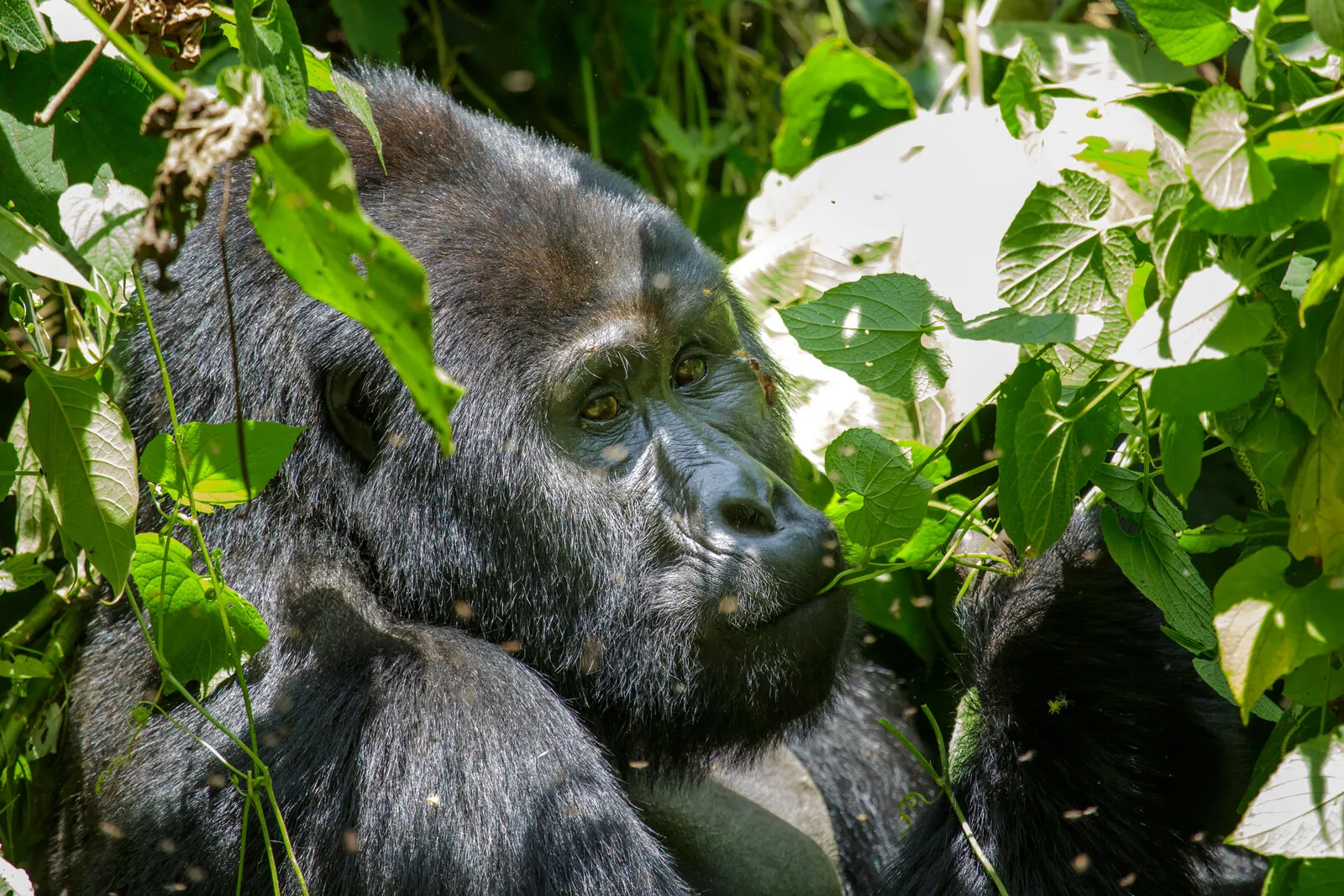
Gorilla Permits
Uganda's $800 UWA gorilla permit explained: how booking works, the new $600 low-season rate, Rwanda's $1,500 comparison, and the Habituation Experience.
Photo: Thomas Fuhrmann, CC BY-SA 4.0, Wikimedia Commons
Why go
An $800 gorilla permit is, on paper, a piece of paper: proof of payment that lets you spend one regulated hour with a wild mountain gorilla family, capped at eight visitors per group per day. It is also, deliberately, one of the most expensive hours of wildlife viewing on the planet, and the price is not an accident of tourism marketing — it’s rationing. Uganda and Rwanda both cap daily permits hard against a fixed roster of habituated families, because the entire point of the fee is to fund the ranger patrols, veterinary monitoring, and anti-poaching work that keep a critically endangered species alive in two small forests. You’re not paying for a guaranteed sighting, a comfortable trek, or a refund if the trail runs long — you’re paying into the machinery that makes the sighting possible at all, and the machinery is expensive to run.
What makes this page worth reading before you hand your money to anyone is that the same product is priced completely differently depending on which side of a national border you buy it. Uganda’s $800 permit is valid in either of its two gorilla parks — Bwindi Impenetrable, with roughly 19 habituated families spread across four sectors, and Mgahinga Gorilla National Park, smaller and quieter, priced on the exact same tariff line as Bwindi despite the very different experience on offer. Rwanda’s Volcanoes National Park charges $1,500 flat, almost double, for a shorter drive from Kigali and generally gentler terrain. Congo’s Virunga National Park, historically the cheapest of the three options, isn’t sellable at any price right now — its own visitor site states plainly that gorilla treks are closed until further notice, a function of the security situation in eastern DRC rather than anything to do with the gorillas themselves. None of these numbers move independently of politics, conservation funding decisions, or, in Congo’s case, an active security crisis — which is exactly why a page like this needs a “last verified” date rather than a price you can treat as permanent.
There’s also a premium tier worth knowing about before you commit to the standard hour: the Gorilla Habituation Experience, currently $1,500 and rising to $1,800 on 1 January 2027, trades four times the standard visit length and a much smaller group size for a meaningfully higher price and a narrower booking window — it exists in exactly one place, Bwindi’s Rushaga sector, and nowhere in Rwanda or Mgahinga. Deciding whether any of this is “worth it” is less a question this page can answer for you than one it can make sure you’re answering with the real numbers in front of you, not a tour operator’s rounded-up quote.
Getting there
Getting a permit into your hands is less a single transaction than a chain of people, and understanding the chain changes how you plan. Uganda’s own tariff document is explicit about the first link: gorilla and chimpanzee permits for foreign non-residents and Rest-of-Africa visitors can only be booked through a licensed tour operator — there is no consumer checkout on UWA’s own website for this specific product, whatever some third-party blogs imply. Your operator submits your details to UWA, checks availability against a specific gorilla family and sector, and pays UWA directly through one of several channels UWA lists on its own tariff sheet: mobile money, point-of-sale machines, bank transfer, or an online payment portal that the operator uses on your behalf rather than one you log into yourself. What you pay your operator is the permit fee plus their margin for handling the booking, transport, guiding, and usually accommodation — bundled land packages commonly run $1,050–$1,450 per person for a few days including the permit, though it’s worth reading any quote closely, since some budget packages price transport and lodging only and expect you to cover the $800 permit as a separate line.
One mechanical change from early 2026 is worth knowing before you start emailing operators: UWA suspended its old 7-day unpaid reservation window on 1 March 2026. Operators used to be able to provisionally hold a permit for a week without paying, giving travelers a short buffer to confirm dates and send funds; that buffer is gone, and permits are now only secured against full payment at the moment of booking. Combined with permits selling out 6 months or more ahead of the June–September and December–February peaks (3–6 months for quieter shoulder months), the practical upshot is that the moment you’re serious about a date, your operator needs your money, not just your interest.
If Rwanda is in the mix — and for southern Bwindi sectors like Rushaga and Nkuringo, or for Mgahinga, it often makes more logistical sense than routing through Kampala — the calculus shifts. Rwanda’s Volcanoes National Park permit is priced and booked separately from Uganda’s system: $1,500 flat per foreign visitor, set by the Rwanda Development Board, bookable either through RDB directly or through an operator the same way as in Uganda. Kigali to Volcanoes National Park is a genuinely short transfer, roughly three hours on a good paved road, against Kampala to Bwindi’s considerably longer haul or Rushaga and Nkuringo’s own 4–5 hour road link to Kigali via the Cyanika border crossing. A trip that treks in Uganda and flies home via Kigali, or vice versa, is common enough that both countries’ tourism industries are built around it — just don’t assume your Uganda permit does anything for you on the Rwandan side of that border, or that a Rwandan itinerary saves you money; it’s the opposite trade, shorter drive and easier trail for close to double the permit price.
When to go
Gorilla tracking runs every day of the year in both countries — there’s no closed season, because UWA and RDB track and permit the same habituated families through every month on the calendar. What changes with the season is trail comfort, crowding, and now, genuinely, price. Uganda’s two dry windows, December through February and June through August, bring firmer trails and less waterlogged forest floor, and they’re also when permits are hardest to get, selling out 6 months or more ahead. The wetter stretches — roughly March to May and September to November — mean muddier, slower treks, but they’re also quieter, and as of the 26 February 2026 UWA memo, three of those months now come with a real price break: $600 instead of $800 for foreign non-residents specifically in April, May, and November, non-reschedulable once booked. That’s a genuine 25% discount for accepting worse footing in exchange for thinner crowds, and if your travel dates have any flexibility at all, it’s worth building your trip around rather than treating as an afterthought.
Whatever season you land in, you need to be at least 15 years old — UWA’s own tracking rules set that minimum explicitly, alongside the 8-visitor cap and the requirement to keep 10 metres from the gorillas at all times, and it applies at Bwindi and Mgahinga alike. There’s no formal fitness screening before you’re allowed on a trek, but the terrain doesn’t care about that omission: treks range from under an hour to most of a day depending on where the family has wandered since the last sighting, over ground that’s steep and often slick regardless of month. Hiring a porter — typically $15–20 for the day plus a $5–15 tip, arranged locally through a community porter association rather than through UWA — is less a luxury than a genuinely practical way to keep a hard trek from becoming a miserable one, and the fee lands directly with the community around the park rather than passing through any tour operator’s margin.
The numbers
| What you pay | Cost |
|---|---|
| Gorilla Tracking permit, standard/high season — valid in Bwindi (BINP) or Mgahinga (MGNP) (FNR / FR / ROA / EAC) UWA Conservation Tariff, July 2024–June 2026 cycle. The tariff prices both parks on the exact same line — Mgahinga is not a budget alternative to Bwindi, it's identically priced. Confirmed unchanged today by the 26 Feb 2026 UWA Executive Director memo, which leaves this figure untouched through at least 1 January 2027 | $800 / $700 / $500 / UGX 300,000 |
| Gorilla Tracking permit, low season — April, May, November only (FNR / FR) New discount from the 26 Feb 2026 UWA memo, effective immediately on issue. Non-reschedulable once booked; ROA/EAC rates for this discount weren't published in the memo | $600 / $500 |
| Gorilla Habituation Experience, current rate (FNR / FR / ROA / EAC) Rushaga sector only, capped at 4 visitors per group, 4 hours instead of the standard 1. The same 26 Feb 2026 memo confirms this rises to $1,800 / $1,600 / $1,000 / UGX 750,000 on 1 January 2027 | $1,500 / $1,000 / $1,000 / UGX 750,000 |
| Rwanda — Volcanoes National Park gorilla permit (all foreign visitors) Set by the Rwanda Development Board in 2017 and unchanged since, per RDB's own tariff page and cross-checked against multiple 2026 operator sites. No FNR/FR/ROA split like Uganda's — one flat rate for all foreign trekkers; EAC citizens pay a separately subsidized rate | $1,500 flat |
| DR Congo — Virunga National Park gorilla permit Virunga's own visitor site states gorilla and Nyiragongo treks are 'closed until further notice,' consistent with the M23-linked security situation in eastern DRC's North Kivu region through 2026. Don't book anything here off a third-party price quote until the park's own site changes | Not currently bookable |
| Porter hire + tip, per trekker (private arrangement, not a UWA fee) Not on the UWA tariff — porters are hired locally through each sector's community porter association on the morning of your trek. Figures are the range most consistently quoted by Bwindi-focused operator sites, not an official rate card | $15–20 hire / $5–15 tip |
Common questions
Can I book a gorilla permit directly with UWA, or do I need a tour operator?
For foreign non-residents and Rest-of-Africa visitors — which is almost every reader of this page — you need a licensed tour operator. UWA's own Conservation Tariff document states it plainly under Payments: 'ALL Gorilla and chimpanzee permits for FNR & ROA can only be booked through licensed tour operators,' pointing to UWA's own tour-operator directory at utb.go.ug/tour-operators. Your operator submits your booking and pays UWA directly, using one of several channels UWA lists: mobile money, POS machines, bank transfer, or UWA's online payment portal — but that portal is something your operator uses on your behalf, not a consumer-facing 'buy your own permit' checkout. In practice this means the price you pay an operator includes their service fee on top of the $800 permit itself; land packages that bundle transport, guiding, and accommodation around a Bwindi trek commonly run $1,050–$1,450 per person for a few days, permit included, though bare-bones budget packages sometimes quote a price that's transport and lodging only, with the permit purchased separately — read the inclusions line by line before assuming a quoted number is your total cost.
How far ahead do permits actually sell out?
Operators and UWA-adjacent guidance are consistent on this: 6 months or more for the June–September and December–February peak windows, and 3–6 months for quieter shoulder months, because supply is hard-capped at 8 trekkers per gorilla family per day across a fixed roster of habituated groups. What changed in 2026 is the mechanics of holding a date: UWA suspended its 7-day unpaid reservation window on 1 March 2026, per the same February memo that introduced the low-season rates. Operators used to be able to provisionally hold a permit for a week before paying; now the system only secures a permit against full payment at the moment of booking. That doesn't change how far ahead you should start the process, but it does mean the lead time that matters most is how fast your operator can get your money to UWA once a date is confirmed, not how long they can hold a placeholder for you.
Uganda or Rwanda — which permit should I actually buy?
It's a real tradeoff, not a marketing question. Rwanda's Volcanoes National Park permit costs $1,500 against Uganda's $800 — nearly double — but buys a shorter, easier trip: Kigali to the park is roughly 3 hours on a good paved road, and the terrain is more open, with better-defined trails than Bwindi's dense, often steep forest (Rwanda's higher elevation is its own tradeoff for some trekkers). Uganda costs less than half as much and, in Bwindi, offers roughly 19 habituated families spread across four sectors versus Rwanda's smaller roster, meaning more schedule flexibility if your first-choice date is full — but you're trading that savings for a longer, muddier, more physically demanding trek and a considerably longer drive from Kampala. There's no universally correct answer: if your budget is the binding constraint and you don't mind the harder walk, Uganda is the stronger value; if you're short on trip days or trekking with less-fit companions, Rwanda's shorter transfer and gentler terrain can be worth the premium.
What's the Gorilla Habituation Experience, and how does booking it differ from standard tracking?
It's a longer, smaller, more expensive alternative: four hours with a semi-habituated gorilla family instead of the standard one hour, capped at 4 visitors instead of 8, and offered only in Bwindi's Rushaga sector — it isn't available in Mgahinga or anywhere in Rwanda. It currently costs $1,500 for foreign non-residents, the same booking-through-an-operator rule applies, and because the visitor cap is half the size of a standard trek, these permits are scarcer and worth locking in earlier, not later, especially since UWA's own 26 February 2026 memo confirms the price rises to $1,800 on 1 January 2027 — booking a 2027 date before that change takes effect locks in today's lower rate.
What happens if I don't find the gorillas, or need to cancel?
If you and your group track for the full day and the ranger team can't locate your assigned family, permit-guidance published by Bwindi-focused travel sites (this is UWA's stated policy as summarized by third parties, not a document UWA itself publishes online) says you're eligible for at least a 75% refund of the tracking fee, processed through UWA headquarters in Kampala rather than on the spot. Cancellations follow a separate sliding scale tied to how far out you cancel — worse the closer you get to your date, with nothing refunded inside roughly the last week before tracking and progressively better refund percentages the earlier you cancel, up to several months out. Illness cancellations at the park itself are handled at the discretion of the warden in charge. None of this is guaranteed cash-in-hand on the day — budget for it as a possible partial recovery, not a certainty.
Is there an age minimum, and what should I know about fitness and porters?
Yes — UWA's own gorilla tracking rules set the minimum age at 15, listed directly in the Conservation Tariff document alongside the 8-visitor cap and the 10-metre distance rule; this applies at both Bwindi and Mgahinga. There's no formal fitness test, but treks are genuinely variable — anywhere from under an hour to most of a day, over steep, often muddy or slippery terrain depending on where your assigned family has moved since the last sighting. Hiring a porter is one of the most consistently recommended ways to make a hard trek manageable: it typically costs $15–20 to hire one for the day plus a $5–15 tip, they carry your daypack and offer a hand on the steep sections, and the fee goes directly to a local community porter association rather than UWA — it's as much a direct-benefit gesture to the community around the park as it is a practical convenience.
- Uganda Wildlife Authority — Conservation Tariff, July 2024–June 2026
- Uganda Wildlife Authority — Introduction of Low Season Gorilla and Chimpanzee Permit Rates and Revised Tariff Structure (26 Feb 2026 memo)
- Rwanda Development Board — Increase of Gorilla Permit Tariffs
- Visit Virunga — official park visitor site (current activity status)
- SafariBookings — Gorilla Trekking: Uganda Versus Rwanda, Which Is Better?
- Bwindi Impenetrable National Park — Gorilla Permit Cancellation Policy
- Bwindi Gorilla Trekking Safaris — Hiring a Porter on a Gorilla Trek in Bwindi
Seen on TikTok & YouTube
Real clips from travelers on the ground, verified before they're linked below.