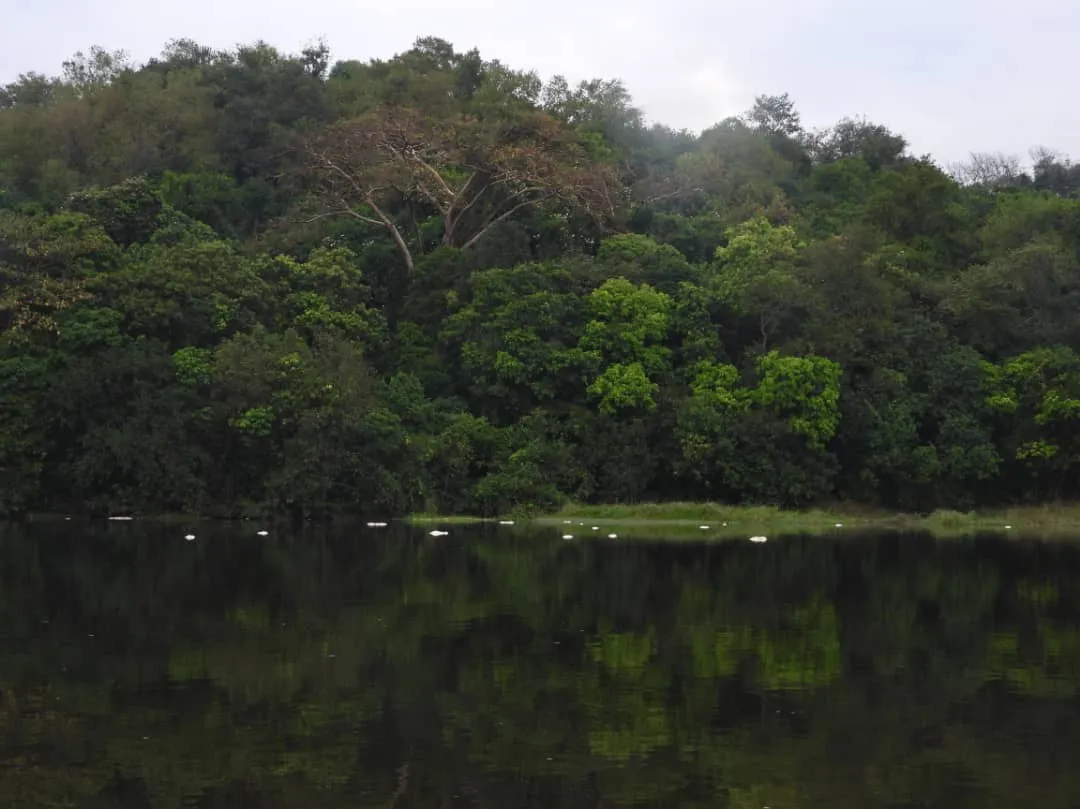
Mabira Forest
Uganda's closest rainforest to Kampala: ziplining at Griffin Falls, red-tailed monkeys, ~315 bird species, and the country's only endemic primate.
Photo: Ndahiro Derrick, CC BY-SA 4.0, Wikimedia Commons
Why go
Driving out of Kampala on the Jinja road, Mabira arrives suddenly: a wall of green closing in on both sides of the highway where, a few kilometres earlier, there was only farmland and roadside market stalls. At roughly 300 square kilometres, it’s the largest surviving natural forest this close to the capital, and for a huge share of Kampala’s population it’s the only rainforest they’ll ever set foot in without a multi-day trip west. That accessibility is the whole point — Mabira isn’t competing with Bwindi or Kibale on scale or rarity of wildlife, it’s the forest you can do as a half-day or full-day trip and still be back in the city for dinner.
What is genuinely rare here is easy to miss if you’re only there for the zipline. Mabira holds one of the largest populations of the Uganda mangabey (Lophocebus ugandae), a primate described as its own species in 2007, though the classification is still debated among primatologists, and is, as far as researchers can tell, Uganda’s sole endemic primate — found nowhere else on Earth. Red-tailed monkeys are a near-guaranteed sighting on any forest walk, chattering through the mid-canopy in family troops. Above them, NFA’s own 2025 ecotourism brochure and Wikipedia both independently cite roughly 315 recorded bird species, a figure serious birders back up with single-day counts well past 50 — African dwarf-kingfishers, great blue turacos, and Cassin’s hawk-eagle among the reliable finds along the Red-tailed Monkey and Turaco trails.
The forest has also survived an actual fight to exist. In 2007, a government plan to hand over roughly a third of Mabira to a sugar company for cane plantations triggered mass protests in Kampala, several deaths, and an eventual reversal — a reminder that “protected” doesn’t always mean settled, and that this particular stretch of green is here today partly because people pushed back when it was threatened.
Then there’s the adrenaline draw: Griffin Falls Camp’s Super Skyway, opened in 2014 and still widely described by operators as Uganda’s first — and only — zipline canopy course. Five lines strung across the Musamya River gorge send you soaring past ancient hardwoods and over the actual Griffin Falls, with red-tailed monkeys and mangabeys visible from a vantage point almost nobody else in the country gets to see the forest from. It’s touristy in a way Bwindi’s gorilla treks aren’t, and that’s fine — Mabira was never trying to be a wilderness expedition. It’s a rainforest built for a day trip, with real ecological weight underneath the zip-line marketing.
Getting there
Mabira sits directly on the Kampala–Jinja highway (the A109), about 54km from central Kampala — a paved, generally well-maintained drive that takes roughly an hour to an hour and a half depending on traffic through Mukono and Lugazi, though congestion out of Kampala can stretch that closer to two hours at peak times. Coming from Jinja, it’s a shorter hop of roughly 20–25km, around half an hour.
The forest has two distinct access points, and knowing which one you want before you set off saves a wasted trip. NFA’s own visitor centre sits right off the highway at Najjembe village — look for the roadside market and a signpost pointing down a short murram side road, about 500m off the tarmac — and this is the base for NFA-guided nature walks, birding along the Red-tailed Monkey and Turaco trails, and basic camping or banda accommodation. Griffin Falls Camp, home to the Super Skyway zipline and the waterfall itself, is a separate site roughly 10km further off the highway near Wasswa village, run independently by the Mabira Forest Integrated Community Organisation (MAFICO), a local community NGO rather than NFA directly.
Getting to the Najjembe centre by public transport is genuinely easy: matatus run constantly in both directions along the Kampala–Jinja highway, and the standard move is simply telling the conductor you want Najjembe. From Kampala’s old taxi park that’s about an hour and roughly 1,500 UGX; from Jinja’s taxi park, headed toward Lugazi or Kampala, it’s closer to half an hour for the same fare. Reaching Griffin Falls Camp itself is less straightforward without your own vehicle, since the final 10km runs down a side road that matatus don’t cover — most visitors either book a package tour that includes door-to-door transport (several operators run one-day Kampala or Jinja pickups built around the zipline specifically), or arrange a boda-boda or special-hire taxi onward from Najjembe. Given that the camp’s own website was unreachable when we checked, booking a package through an established operator is also the more reliable way to confirm current zipline availability and pricing before you travel, rather than counting on walking in and arranging it on the spot.
When to go
Unlike Uganda’s mountain parks, Mabira doesn’t have a hard access problem outside the dry months — it’s a lowland rainforest a short drive from Kampala, and it runs as a year-round day-trip destination regardless of season. That said, the same broad pattern applies if you want the easiest trail conditions and the clearest zipline visibility: the two dry windows are December–February and June–August, when forest paths are firmer underfoot and the canopy views from the Super Skyway aren’t competing with rain.
The wetter stretches, roughly March–May and September–November, bring heavier and more frequent showers, muddier sections on the nature-walk trails, and a real chance of a zipline session getting paused or rescheduled around a downpour. In exchange, the forest is at its most vivid in this period — deeper greens, more visible butterfly activity, and noticeably thinner crowds, which some visitors and budget travellers actively prefer, since accommodation rates around Najjembe and Griffin Falls Camp tend to soften when fewer people are booking.
Whatever month you go, pack for humidity and at least the possibility of rain regardless of the “dry” label — Mabira sits close enough to the equator, and low enough in elevation, that a clear morning can turn into an afternoon downpour even in August. A light rain layer and shoes you don’t mind getting muddy will cover you across any season, and unlike a multi-day mountain trek, a rained-out morning here just means rescheduling the zipline for later the same day rather than losing a summit window entirely.
Where to stay
- Rainforest Lodge by CityBlue
Cottages built into the forest itself near Najjembe, with viewing decks looking straight into the canopy — the closest you can sleep to the trailhead
- Griffin Falls Camp (MAFICO community camp)
Budget bandas, eco-nests, and camping right at the zipline site, run by the Mabira Forest Integrated Community Organisation; book by phone/email, not through an online platform — see note below
- Jinja Nile Resort
Riverside resort in Jinja, a manageable base if you're combining Mabira with Nile-side activities before or after
Tours
- Jinja Tours — 1 Day Zip-Lining at Mabira Forest Tour
Full-day package from Kampala or Jinja: transport, guide, nature walk, and the Super Skyway zipline
- Wild Adventure Safaris — Zip-Lining in Mabira Forest
Day-trip zipline package with pickup from Kampala; pairs well with a Jinja add-on
- Gorilla Uganda Safaris — 1 Day Mabira Forest Ziplining Tour
All-inclusive day tour bundling park fees, ziplining, guide, and transport in a standard safari vehicle
The numbers
| What you pay | Cost |
|---|---|
| NFA forest entry permit, per visit (Ugandan / resident / foreign non-resident) Figure most consistently repeated across current tour-operator fee pages (e.g. safaris-uganda.com), undated. NFA's own Mabira ecotourism page still displays an explicit 1999 fee table (1,000–6,000 UGX) despite the page showing a 2026 'last modified' timestamp — the official source itself is stale, so treat the figure above as best-available, not primary-confirmed | 5,000 / 10,000 / 20,000 UGX |
| Guided nature walk, per person (Ugandan / resident / foreign non-resident) Same tour-operator aggregate source as above, no confirmed publication date | 5,000 / 15,000 / 30,000 UGX |
| Super Skyway zipline at Griffin Falls Camp, foreign non-resident Griffin Falls Camp's own pricelist and Super Skyway pages both returned a live HTTP 404 today, so this could not be confirmed directly from the operator. $50 is the figure most repeated by third-party aggregators; a 2016-era visitor review cited $40, suggesting a rise since. Budget more if booking through a guided day-tour package (see below) | roughly $50 (60,000 UGX for Ugandans) |
| 1-day guided zipline tour from Kampala/Jinja, foreign non-resident Jinja Tours' own live package page, fetched today; includes transport, guide, nature walk, and zipline access — not directly comparable to the admission-only price above | $70 per person |
| Guided birdwatching, half/full day Tour-operator aggregate figure, undated | 100,000–150,000 UGX |
| Uganda mangabey / primate tracking, per person (Ugandan / foreign non-resident) Tour-operator aggregate figure, undated | 50,000 / 100,000 UGX |
Common questions
Is Mabira Forest a national park run by Uganda Wildlife Authority?
No. Mabira is a Central Forest Reserve gazetted in 1932 and managed by the National Forestry Authority (NFA), a completely different government body from Uganda Wildlife Authority (UWA), which runs the national parks. That distinction matters for fees: Mabira isn't on UWA's Conservation Tariff at all, and entry/activity charges are set separately by NFA and by the community organisation that runs the zipline, not by the tariff that governs Bwindi, Rwenzori, or Mount Elgon.
How much does the zipline at Griffin Falls actually cost?
The honest answer is that no one, including the operator, could confirm it to us today — Griffin Falls Camp's own pricelist and zipline pages were both returning a dead link when we checked. The figure most consistently quoted across independent tour sites is around $50 for foreign visitors (60,000 UGX for Ugandans) for the zipline alone, up from roughly $40 in older visitor reviews. A full guided day-tour package that bundles transport, a guide, and a nature walk with the zipline runs closer to $70 per person on at least one operator's own current booking page. Confirm directly with whichever operator you book through before you travel.
Is Griffin Falls Camp the same place as the main Mabira Forest entrance?
Not quite, and mixing them up is a common trip-planning mistake. NFA's forest visitor centre sits right off the highway at Najjembe, about 500m down a side road, and is the base for NFA-guided nature walks and birding. Griffin Falls Camp — home of the Super Skyway zipline and the actual Griffin Falls waterfall — is a separate site about 10km further off the highway, run by the Mabira Forest Integrated Community Organisation (MAFICO), a local NGO. If ziplining is the goal, you're headed to Griffin Falls Camp specifically, not just 'Mabira Forest' generically.
How many bird species does Mabira actually have?
Roughly 315, if you go by NFA's own 2025 ecotourism brochure and Wikipedia, which independently agree on that number. Plenty of tour-operator pages round it up to 316; the difference isn't meaningful for trip planning, but 315 is the figure with the more traceable sourcing. Either way, it's one of the best birding sites this close to Kampala, with recorded single-day counts well above 50 species.
Can I visit Mabira without a car?
Yes, easily, if you're headed to the roadside NFA centre. Matatus run constantly along the Kampala-Jinja highway; tell the conductor you're getting off at Najjembe and it's about an hour and roughly 1,500 UGX from Kampala's old taxi park, or half that from Jinja. Reaching Griffin Falls Camp itself by public transport is harder, since it's 10km down a side road off the highway — most visitors either book a guided day-tour package that includes transport, or arrange a boda-boda or special-hire taxi from Najjembe.
Seen on TikTok & YouTube
Real clips from travelers on the ground, verified before they're linked below.