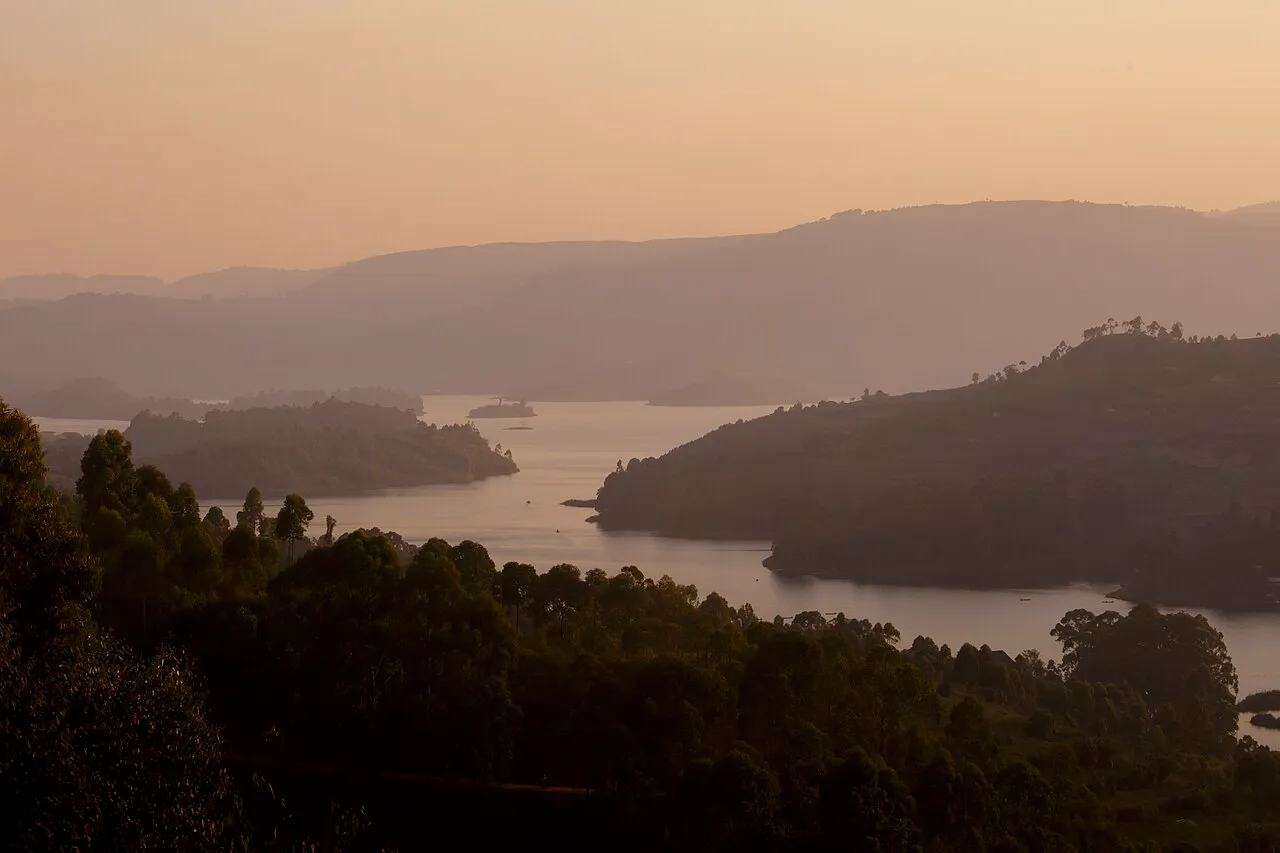
Lake Bunyonyi
Canoe among Lake Bunyonyi's 29 islands from Kabale, including Punishment Island's history — the 'second-deepest lake' and bilharzia-free claims, checked.
Photo: Thomas Fuhrmann, CC BY-SA 4.0, Wikimedia Commons
Why go
Lake Bunyonyi sits at 1,962m in Uganda’s far southwest, ringed by terraced hillsides so steep and so completely farmed that the whole basin looks sculpted rather than grown. Twenty-nine islands break its surface, most too small to hold more than a homestead or a stand of trees, and the water itself is startlingly still — no hippos, no crocodiles, and by most accounts none of the bilharzia risk that keeps swimmers out of many other African lakes. It’s less a single attraction than a place to slow down: after the adrenaline of a Bwindi gorilla trek an hour or two away, Bunyonyi is where a lot of itineraries deliberately go quiet, with a canoe paddle standing in for an activity list.
It’s also a good place to practice reading tourism copy with a critical eye, because two of the lake’s most-repeated claims don’t hold up cleanly. The first is depth: guides and lodge websites — including Uganda’s own tourism board — like to call this the second-deepest lake in Africa, at roughly 900m. Wikipedia’s own account cites scientific literature putting the real maximum depth closer to 40m, a difference too large to be rounding error. The second is the “bilharzia-free” label. It’s mostly true in the sense that matters to a traveler — no documented infections traced to swimming here — but a peer-reviewed snail survey found the actual parasite-carrying snail species has been present in the lake since the 1930s. Neither claim is a lie exactly; both are simplifications worth knowing before you repeat them yourself.
The human history is where Bunyonyi gets genuinely heavy. Akampene, known to visitors as Punishment Island, is barely large enough to stand on, and it’s where Bakiga families once abandoned unmarried pregnant daughters, a practice bound up in the value placed on premarital virginity and bride-price economics. Some girls drowned trying to swim to shore; others were taken in by men too poor to pay a standard bride price. The practice ended in the early-to-mid 20th century, and today it’s a stop on most canoe and boat tours — a stark contrast dropped into an otherwise idyllic paddle past terraced farmland and fishing villages.
Unlike Bwindi, Mgahinga, or Mount Elgon, Bunyonyi isn’t a UWA-managed park — there’s no entrance fee, no permit, no gate to pass through. You simply show up, hire a boat or canoe, and pick a lodge. That makes it one of the easiest, least bureaucratic stops in southwestern Uganda, and the reason it shows up on so many itineraries as an add-on rather than a destination in its own right — though plenty of visitors end up staying longer than planned once they’re there.
Getting there
Kabale, Uganda’s southwestern regional hub, is the gateway town, and the lake itself is a further 7–8km beyond it — about 20 to 30 minutes by road on the paved Kabale–Lake Bunyonyi Road, completed in 2022. From Kampala, that’s roughly 410km and generally a 6 to 7 hour drive via Masaka and Mbarara; public buses cover the same route in around 8 hours with stops. It’s a long day either way, which is why most travelers pair the drive with a stop in Mbarara or fold it into a longer loop that also covers Bwindi or Queen Elizabeth National Park rather than treating it as a standalone day trip from Kampala.
Coming from Rwanda is increasingly common, since Bunyonyi sits close enough to the border to work as a first or last stop on a Uganda–Rwanda gorilla-trekking combination. The Katuna (Uganda side) / Gatuna (Rwanda side) crossing is about 80km from Kigali and roughly 30km short of the lake, so a full Kigali-to-Bunyonyi run — including the border formalities — typically runs 2.5 to 3.5 hours. A third route worth knowing about: Aerolink flies Entebbe to Kisoro airstrip in about 1 hour 15 minutes, primarily serving Bwindi’s southern sectors and Mgahinga Gorilla National Park; from Kisoro it’s about 48km, roughly an hour, on to the lake. That combination — fly to Kisoro, trek gorillas, drive to Bunyonyi to decompress — is a well-worn pattern for travelers short on days.
Once at the lake, getting around is entirely boat-based. Motorboats run from Rutinda jetty to island lodges in 10 to 15 minutes; dugout canoes, paddled or guided, are the slower, cheaper, and more atmospheric way to reach the same places or simply explore the shoreline and islands at your own pace.
When to go
Bunyonyi follows Uganda’s usual dry-season pattern — June through August, and December into February — though the altitude means the lake stays cool and comfortable year-round regardless of season, unlike the lowland parks. Dry months bring clearer water and calmer paddling conditions, along with better visibility across the islands and terraced hills that make the lake worth photographing in the first place. The wetter stretches, March to May and September to November, bring more cloud and the kind of low mist that regularly rolls across the water at dawn — atmospheric if you’re there for it, though it can delay an early canoe outing.
Because there’s no permit system and no seasonal booking crunch the way there is for gorilla trekking, timing a Bunyonyi visit is mostly about weather rather than availability — book lodging ahead in peak safari months if you’re combining it with a Bwindi trek, but the lake itself rarely turns visitors away.
Where to stay
- Byoona Amagara Island Retreat
Community-owned, not-for-profit retreat on Itambira Island, reached by boat from the mainland — dorms through private lakeview huts
- Bunyonyi Overland Resort
Mid-range cottages and tents on the lakeshore, a short walk from Bushara boat launch
- Lake Bunyonyi Rock Resort
Higher-end cottages built into the rock above the lake, with canoeing and boat tours run directly from the property
Tours
- Gorilla Highlands — Touch of Bunyonyi canoe tour
2-hour guided dugout canoe outing with a local paddler; pickup from most lakeside resorts
- Rent a Boat Uganda — Lake Bunyonyi
Motorboat and canoe hire for independent island-hopping
- SafariBookings — Lake Bunyonyi tours
Compare itineraries from dozens of operators, mostly bundled with Bwindi gorilla trekking
The numbers
| What you pay | Cost |
|---|---|
| Dugout canoe hire, per person (unguided, 30–45 min) Rate from a local Lake Bunyonyi guide; most lakeside camps rent canoes directly, prices vary by operator | UGX 10,000 (about $3) |
| Guided canoe tour, 2 hours Gorilla Highlands 'Touch of Bunyonyi' rate, sliding by group size ($60 solo, down to $20 for 8+); includes guiding, dugout, tips, and a drink | $20–60 per person |
| Motorboat transfer to an island lodge, one-way per person Typical rate for the 10–15 minute crossing to Byoona Amagara or Bushara Island from Rutinda jetty; negotiable and cheaper for return trips arranged with a lodge | UGX 20,000 (about $5.50) |
| Special-hire taxi, Kabale town to the lakeshore 20–30 minute drive; boda-boda is cheaper at roughly UGX 7,000–12,000 but with luggage limits | UGX 30,000–50,000 (about $8–14) |
| Lodging, per night Spans Byoona Amagara's community dorms, Bunyonyi Overland Resort's mid-range cottages, and Lake Bunyonyi Rock Resort's higher-end rooms — see Booking.com listings for current rates | $17 dorm bed to $150+ premium cottage |
Common questions
Is Lake Bunyonyi really the second-deepest lake in Africa?
That claim is disputed, and it's worth knowing which side you're reading. Uganda's own tourism board site repeats the popular figure of roughly 900m, which would indeed make it Africa's second-deepest lake after Lake Tanganyika. But Wikipedia's article on the lake cites scientific literature putting the maximum depth at around 40m — a huge gap from the 900m figure, and one that would put Bunyonyi well behind Uganda's own Lake Victoria and Lake Mutanda, let alone any African ranking. The 900m number appears to trace back to tour-guide folklore rather than a published survey; treat it as a great story, not a verified fact.
Is it actually safe to swim — is Lake Bunyonyi bilharzia-free?
Mostly, but 'bilharzia-free' is a stronger claim than the science fully backs. Tourism sites confidently call the lake free of bilharzia, pointing to its cool, high-altitude water as inhospitable to the snails that carry the parasite. A peer-reviewed study on schistosomiasis-snail distribution in Uganda found that Biomphalaria snails — the intermediate host for the parasite — have in fact been present at Lake Bunyonyi since the 1930s and remain there today. The same research references an earlier 2006 survey of children and mothers at a lakeside village that found no evidence of actual schistosome infection despite the snails' presence. In short: the snail that can carry the disease is documented in the lake, but documented human infections from swimming there are not — which is a more honest way to put it than a flat 'bilharzia-free' guarantee.
What's the story behind Punishment Island?
Akampene, a speck of an island barely big enough to stand on, was where the Bakiga abandoned unmarried girls who became pregnant — a practice rooted in the value placed on virginity before marriage and the shame (and lost bride-price) an out-of-wedlock pregnancy brought a family. Girls were left to starve or drown attempting to swim to shore; some were rescued by men too poor to pay a standard bride price, who took them as wives without stigma attached to the arrangement. The practice died out in the first half of the 20th century, generally credited to missionary influence in the area. Boat tours stop at the island today as a short, sober counterpoint to the lake's postcard scenery.
Do I need a park permit or pay UWA fees to visit?
No. Unlike Bwindi, Mgahinga, or Mount Elgon, Lake Bunyonyi isn't a UWA-managed protected area — there's no entrance fee, permit, or gate. You pay directly for what you use: canoe or boat hire, a lodge, a guided tour. That makes it a natural, low-friction stop to fold onto a gorilla-trekking itinerary, which is exactly how most visitors reach it — as a day or two of recovery either side of a Bwindi trek.
How do I get there — from Kampala, or from Rwanda?
From Kampala, it's about 410km to Kabale, the gateway town, generally 6–7 hours by road via Mbarara (public buses run closer to 8); Lake Bunyonyi itself is a further 7–8km, about 20–30 minutes. Coming from Rwanda, the Katuna/Gatuna border crossing is roughly 80km from Kigali and about 30km short of the lake, making the full Kigali-to-Bunyonyi run about 2.5–3.5 hours including the border — a common route for travelers combining Rwanda gorilla trekking with Uganda. A third option is flying Entebbe–Kisoro with Aerolink (about 1h15) and driving the remaining 48km, roughly an hour, useful if you're also visiting Bwindi's southern sectors or Mgahinga.
Seen on TikTok & YouTube
Real clips from travelers on the ground, verified before they're linked below.