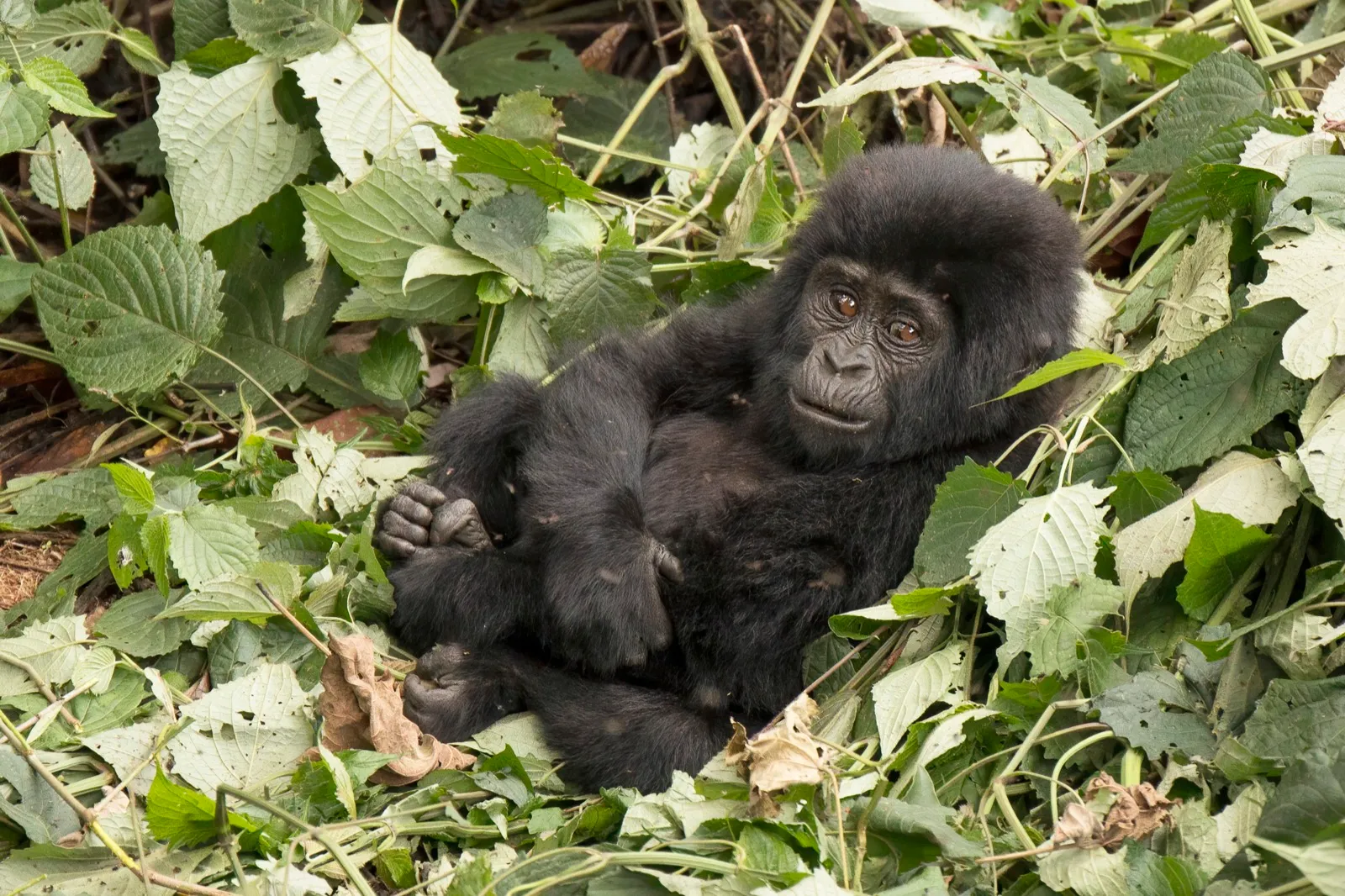
Bwindi Impenetrable
Half the world's mountain gorillas, four trekking sectors, an $800 UWA permit confirmed against the current tariff, and a genuinely new low-season discount.
Photo: Charles J. Sharp, CC BY-SA 4.0, Wikimedia Commons
Why go
“Bwindi” comes from the local word for impenetrable, and standing at the treeline it’s not hard to see why: a wall of tangled undergrowth, vine-choked hardwoods, and steep, mist-wet ridges that has resisted clearing for long enough to become one of Africa’s oldest and most biologically dense forests. Beneath that canopy live roughly half of the world’s remaining mountain gorillas — a 2018 census counted 459 individuals across 36 social groups plus 16 more living alone here, against a global mountain gorilla population that same census put at just over a thousand, split between this forest and the separate Virunga Massif further south. UNESCO inscribed Bwindi as a World Heritage Site in 1994, citing both its outstanding natural beauty and an exceptional concentration of species found nowhere else, a product of sitting exactly where the Albertine Rift, the Congo Basin, and East Africa’s ecological zones all meet.
None of that protection came free. The park was gazetted in 1991 specifically to safeguard the gorillas, and roughly 4,000 Batwa people (the figure most often cited by Batwa advocacy groups), forest-dwelling communities with generations of history here, were evicted with minimal notice and no compensation. Gorilla tracking itself only became a tourist activity in April 1993 — meaning the industry that now generates a meaningful share of Uganda’s conservation revenue was built on land its original inhabitants had been removed from barely two years before. The Batwa Forest Experience offered today, guided by Batwa community members, doesn’t undo that history, but it’s one of the more direct ways it gets acknowledged rather than skipped past in the marketing copy.
What you’re actually paying $800 for is deliberately rationed: a maximum of eight visitors per gorilla family per day, one hour with the group once you find them, and a trek that can run anywhere from under an hour to most of a day depending on where that particular family has wandered since the last sighting. It’s expensive by any standard, and UWA prices it that way on purpose — permit revenue funds a large share of the ranger patrols, anti-poaching work, and community programs that keep the forest and its gorillas intact. Set against that, an hour spent within a few metres of a family group, watching a juvenile tumble through the undergrowth while a 200kg silverback ignores you entirely, reads less like a wildlife encounter and more like being let into somewhere you were never supposed to get this close.
Getting there
Bwindi sits in Uganda’s far southwest, and getting there is a genuine undertaking whichever way you choose — there’s no version of this trip that’s a quick side excursion. By road from Kampala it’s roughly 550km, generally 8-9 hours split across two legs: Kampala to Kabale, around 414km and 5-8 hours depending on traffic and road conditions, then a further 120km from Kabale through Kanungu to the Buhoma park headquarters, on a slower, partly unpaved stretch. Most people traveling by road break the drive with a night in Kabale rather than pushing straight through.
Flying cuts that dramatically: Aerolink runs daily flights from Entebbe into two airstrips serving the park, Kihihi (about 1 hour 10 minutes, and the more convenient option for Buhoma and Ruhija) and Kisoro (also around 1 hour 10 minutes, better positioned for Rushaga and Nkuringo). Given how much of an 8-9 hour road transfer eats into a short trip, flying in is the standard choice for anyone not already road-tripping through southwestern Uganda for other reasons.
There’s a second routing worth knowing about if your itinerary includes Rwanda: Rushaga and Nkuringo, the two southern sectors, are both easier to reach from Kigali than from Kampala — roughly 4-5 hours by road via the Cyanika border crossing, versus a considerably longer haul down from Kampala on the Ugandan side. Plenty of trekkers booked into these two sectors fly into Kigali, cross the border by road, and never see Kampala at all. Buhoma and Ruhija, by contrast, are more naturally reached via the Katuna/Gatuna border route or directly from Kampala, and Ruhija in particular has rougher approach roads that make a 4WD vehicle genuinely useful rather than a nice-to-have.
The practical takeaway: know which sector your permit is for before you book transport or accommodation, not after. The four sectors are spread far enough apart across the park’s edges that “staying near Bwindi” doesn’t mean much on its own — a lodge booked for Buhoma does you no good if your trek is out of Rushaga the next morning.
When to go
Bwindi follows Uganda’s familiar two-dry-season pattern — December through February, and June through August — when trails are firmer, forest floors less waterlogged, and the steep sections on sectors like Nkuringo noticeably less treacherous underfoot. The wetter stretches, roughly March to May and September to November, bring heavier daily rain, muddier ridge trails, and treks that can run longer simply because the going is slower.
Unlike a mountain summit that can become genuinely unsafe or impassable outside its dry window, gorilla tracking happens daily, year-round, rain or shine — UWA tracks and permits the same habituated families through every month of the year, so “when to go” here is really a question of trail comfort and crowding rather than whether the trip is possible at all. That distinction matters more this year than usual: UWA’s own 26 February 2026 memo introduced a genuine low-season discount, $600 instead of $800 for foreign non-residents, specifically for permits used in April, May, or November. That’s real money back for accepting muddier trails and thinner crowds in three of the wettest, quietest months on the calendar — worth serious consideration if your dates have any flexibility at all, though those discounted permits can’t be rescheduled once booked, so be confident in your travel dates before committing.
Whatever season you land in, budget real buffer time around the trek itself. Permit dates are fixed once assigned by your operator, group sizes are capped, and the 7-day unpaid reservation window UWA used to offer was suspended as of 1 March 2026 — permits are now only secured with full payment at booking, so the lead time that matters most isn’t really about the calendar month, it’s about how far ahead you and your operator lock in payment against a hard-capped daily supply of roughly 152 permits across all four sectors combined.
Where to stay
- Buhoma Lodge
One of only two lodges actually inside the park boundary, steps from the Buhoma trailhead — the easiest sector, best for first-timers or less-fit trekkers
- Rushaga Gorilla Lodge
About 15 minutes' walk from the Rushaga trailhead, the sector with the most habituated families and the only one offering the Gorilla Habituation Experience
- Nkuringo Bwindi Gorilla Lodge
Ridge-top lodge above the toughest of the four sectors — steep descents and climbs, dramatic views toward the Virunga volcanoes across the DRC border
Tours
- SafariBookings — Bwindi gorilla trekking tours
Marketplace comparing itineraries, prices, and reviews across 100+ vetted operators running Bwindi treks
- Gorilla Tracking Uganda — 3 Day Uganda Gorilla Trekking Tour
Budget land package quoted at $490pp sharing — this figure is the transport/guide/accommodation package only and does not appear to include the separate UWA permit fee
- Valiant Safaris — Bwindi gorilla trekking packages
3-day packages quoted at $1,050–$1,450pp with the permit, guide, 4x4, and accommodation bundled into one price
The numbers
| What you pay | Cost |
|---|---|
| Gorilla Tracking permit, standard/high season (FNR / FR / ROA / EAC) UWA Conservation Tariff, July 2024–June 2026 cycle. Confirmed unchanged today by a 26 Feb 2026 UWA Executive Director memo, which leaves this exact line untouched in its own 'revised tariff structure' table (effective 1 Jan 2027) — this is the most rigorously cross-checked figure in this guide | $800 / $700 / $500 / UGX 300,000 |
| Gorilla Tracking permit, low season — April, May, November only (FNR / FR) New discount introduced in the same 26 Feb 2026 UWA memo, effective immediately on issue. Explicitly non-reschedulable once booked; ROA/EAC rates for this discount weren't published in the memo we read | $600 / $500 |
| Gorilla Habituation Experience, current rate (FNR / FR / ROA / EAC) Still the active rate today. The same 26 Feb 2026 UWA memo confirms this rises to $1,800 / $1,600 / $1,000 / UGX 750,000 on 1 January 2027 — book before that date at today's price if this is on your list | $1,500 / $1,000 / $1,000 / UGX 750,000 |
| Park entrance, Category A, per day (FNR / FR / ROA / EAC) UWA Conservation Tariff. Not an extra charge on trekking day — the gorilla permit already bundles one day's park entrance, guide fee, and community development contribution | $40 / $30 / $25 / UGX 20,000 |
| Bird Watching and Nature Walks (FNR / FR / EAC) UWA Conservation Tariff — for visitors doing forest walks without a gorilla permit that day | $40 / $30 / UGX 30,000 |
| Long Walk, Buhoma to Nkuringo (FNR / FR / EAC) UWA Conservation Tariff, current rate. The 26 Feb 2026 memo's 'revised tariff structure' lists this rising to $100 FNR (FR/EAC unchanged) from 1 January 2027 | $60 / $50 / UGX 50,000 |
| Batwa Forest Experience, excludes entrance (FNR / FR / EAC) UWA Conservation Tariff — a half-day cultural walk led by Batwa guides, bookable alongside or instead of gorilla tracking | $40 / $40 / UGX 40,000 |
Common questions
Is the gorilla permit really $800, and has that changed recently?
Yes to both, in the least confusing way possible: $800 for foreign non-residents is what the current UWA Conservation Tariff (July 2024–June 2026) states, and a UWA Executive Director memo dated 26 February 2026 — which introduced several other changes — leaves this specific figure untouched in its own forward-looking tariff table. So $800 has been the number, is the number today, and based on UWA's own published plan will still be the number after their next tariff revision takes effect on 1 January 2027. What is new is a genuine low-season discount: $600 for foreign non-residents (down from $800) in April, May, and November only, introduced in that same February 2026 memo and non-reschedulable once booked.
What's the Gorilla Habituation Experience, and is it worth the extra cost?
It's a longer, smaller-group alternative to standard tracking: four hours with a semi-habituated gorilla family instead of the standard one hour, capped at four visitors instead of eight, and only offered in the Rushaga sector. It currently costs $1,500 for foreign non-residents, but UWA's own 26 February 2026 memo confirms this rises to $1,800 on 1 January 2027 — so if it's on your list and you're planning a 2027 trip, booking before that date locks in the lower rate. Whether it's worth the premium over standard tracking comes down to what you value: standard tracking gets you the same gorillas for a fraction of the time and cost; habituation trades money and an earlier, longer forest day for far more time actually watching the group.
Which of the four sectors should I choose?
It comes down to fitness and how you're routing your trip. Buhoma, in the north, has the gentlest terrain and the most developed lodging — including two lodges inside the park itself — making it the standard pick for first-timers or less-fit trekkers, and it's the easiest sector to reach directly from Kampala. Ruhija, to the east, sits at higher elevation and is the best sector for birders, but has the thinnest lodging selection of the four. Rushaga, in the south, has the most habituated families of any sector and is the only one offering the Gorilla Habituation Experience, with a fast-growing set of mid-range and luxury lodges nearby. Nkuringo, also in the south, is consistently described as the toughest — steep, punishing terrain — in exchange for dramatic ridge-top views toward the Virunga volcanoes across the DRC border. Rushaga and Nkuringo are both reached more easily from Kigali, Rwanda than from Kampala, which matters if you're combining countries on one trip.
How far in advance do I actually need to book a permit?
Tour operators generally recommend 6 months or more ahead for the June–September and December–February peak windows, and 3–6 months for the quieter shoulder months — permits are capped at 8 trekkers per gorilla family, and Bwindi runs roughly 19 habituated families across its four sectors, so the daily supply is hard-capped and does sell out. One mechanical change worth knowing about: UWA suspended its old 7-day unpaid reservation window on 1 March 2026, per the same February 2026 memo. Operators can no longer provisionally hold a permit for a week without paying — permits are now only secured with full payment at the time of booking, which in practice means your operator needs your money before they can lock in your date, not just your name on a list.
Why is it a UNESCO World Heritage Site, and what does 'half the world's mountain gorillas' actually mean?
Bwindi was inscribed in 1994 under UNESCO criteria (vii) and (x), recognizing both its outstanding natural beauty and its exceptional biodiversity — it sits at the meeting point of the Albertine Rift, Congo Basin, and East African ecological zones, and is thought to have served as a Pleistocene-era forest refuge, which helps explain why it holds so many species found nowhere else. On the gorilla count: a 2018 census recorded 459 mountain gorillas in 36 social groups plus 16 solitary individuals living in Bwindi specifically, out of a global mountain gorilla population that census put at just over 1,000 — split between Bwindi and the separate Virunga Massif spanning Uganda, Rwanda, and the DRC. 'About half' is the figure that comparison consistently produces, and it's not marketing language — UWA's own permit structure exists specifically because Bwindi holds that much of a critically endangered species in one forest.
Is Bwindi's protection status connected to any real cost for the people who lived there?
Yes, and it's worth knowing before you go rather than glossing over. Bwindi was gazetted as a national park in 1991, specifically to protect the mountain gorilla population, and roughly 4,000 Batwa people (the figure most often cited by Batwa advocacy groups) — forest-dwelling communities with generations of history in Bwindi — were evicted with minimal notice and no compensation. Gorilla tracking itself only began as a tourist activity in April 1993, meaning the park's now-famous conservation tourism industry was built on land its original inhabitants were removed from just two years earlier. The Batwa Forest Experience offered today, led by Batwa guides, is one of the more direct ways that history gets acknowledged and, to some extent, economically offset — it's a genuinely different activity from gorilla tracking, worth booking on its own terms rather than as an afterthought.
- Uganda Wildlife Authority — Conservation Tariff, July 2024–June 2026
- Uganda Wildlife Authority — Introduction of Low Season Gorilla and Chimpanzee Permit Rates and Revised Tariff Structure (26 Feb 2026 memo)
- Wikipedia — Bwindi Impenetrable National Park
- Duma Explorer — Gorilla Trekking Bwindi Sectors Guide
Seen on TikTok & YouTube
Real clips from travelers on the ground, verified before they're linked below.